Photo manipulation is nearly as old as photography itself,
and what early photographers lacked in Photoshop, they made up for in
ingenuity. Photographers identified nine different methods that could
aid in the photographic imitation of “spirits”, including techniques
like multiple exposure and combination printing. As David Brewster, in
his 1856 book on the stereoscope, explained:
For the purpose of amusement, the photographer might carry
us even into the regions of the supernatural. His art, as I have
elsewhere shewn, enables him to give a spiritual appearance to one or
more of his figures, and to exhibit them as ‘thin air’ amid the solid
realities of the stereoscopic picture.
William Mumler was the world’s first known
“spirit photographer”. He photographed people who were morning the loss
of a loved one and would superimpose their image on the photograph to
show that they were still with them in spirit.
Mumler got caught with his fraudulent photography because of
P.T. Barnum. He had captured an image of Barnum posed next to a ghost of
an exceptionally notable variety: that of the recently assassinated
Abraham Lincoln.
During Mumler’s 1869 hearing for fraud, Barnum was
called to the witness stand to testify against Mumler. Barnum would
serve as an expert on “humbuggery.”
Spirit photography lived on well into the 20th century,
fueled in part by the Civil War and, later on, by World War I. In the
U.K., in the aftermath of the first Great War, the spirit photographer
William Hope would develop a following for his work that included Arthur
Conan Doyle. The Sherlock Holmes’s creator supported Hope against
claims of Mumlerian fraud and wrote a book called The Case for Spirit Photography in
1922. He would also end his friendship with the famous Harry Houdini
when the magician publicly claimed that spirit photography was
“farcical.”
(Source:
The Atlantic)
Many are still shocked to hear the story of how tens of
thousands of people paid to see an exhibit of tiny babies in incubators
in Long Island, New York at Coney Island in the early 19th century. But
there was a very important reason for this, one that continues to save
lives every day.
Incubators, while now standard in any hospital, were once an
untested technology. Their developers needed a way to prove their worth
and get the word out. So Dr. Martin Arthur Couney did the only thing he
could to show the world that this technology was indeed needed and could
save many lives. And that is how premature babies were put on display
at Coney Island, as the “Baby Incubator Exhibit”.
The attraction resembled a normal hospital ward, with babies,
nurses providing specialized care, and the doctor over-looking
everything. The only difference was that they were on display as a paid
exhibit. His medical staff consisted of five wet-nurses and fifteen
highly trained medical technicians including his daughter Hildegarde, a
nurse. By 1939, he had treated more than 8,000 babies and saved the
lives of over 6,500. Dr. Couney never charged parents a fee for the care
he gave their infants. His clinic was financed strictly through
entrance fees.
The exhibit on Coney Island was a spectacular, and seemingly
successful, affair. Outside of the attraction, carnival barkers,
including a very young Cary Grant, pulled people into the exhibit. The
sign over the entryway proclaimed, “All the World Loves a Baby.” Any
child who was prematurely born in the city would be rushed over to Coney
Island to be placed in the exhibit, including Couney’s own daughter,
who spent three months there.
Over time, the ‘graduates,’ of the program came back to
visit Couney and see the new crop of premature babies. In 1939 towards
the end of the attraction’s run, an article in the New Yorker mentioned
that a few of the male graduates became doctors themselves. By the time
his Luna Park exhibit closed in 1943, incubators were being used in
hospitals across the world.
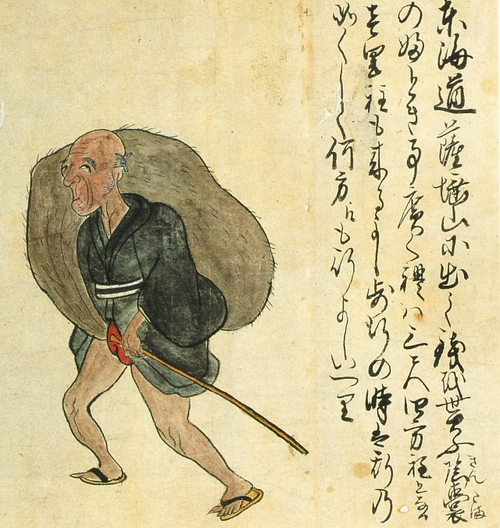
The Kaikidan Ekotoba is a mysterious handscroll that
profiles 33 legendary monsters and human oddities, mostly from the
Kyushu region of Japan (with several from overseas). The cartoonish
document, whose author is unknown, is believed to date from the mid-19th
century.
The above image tells a tale of a man with massive testicles
who reportedly made a living as a sideshow attraction at Mt. Satta, on
the old Tokaido Road near the city of Shizuoka. His scrotum is said to
have measured about a meter across.
Jose Guadalupe Posada (1852 - 1913) was Mexico’s most famous
graphic artist. He illustrated books, novels, and the famous broadsides
(news sheets) that were distributed throughout the country. Many of his
drawings could be considered to be political cartoons. Known especially
for his engravings of the “calaveras” or skeletons that cavort, eat and
drink, ride bicycles and horses, are revolutionaries, street vendors,
and everyday people.
His art is traditional for All Souls’ Day, the Day of the Dead
or “Dia de los Muertos”. The Day of the Dead actually consists of two
days: November 1st for the remembrance of deceased infants and children
and November 2nd for deceased adults.
Millie and Christine McKoy were born, joined at the base of
the spine, on July 11, 1851, the eighth and ninth child of Monimia and
Jacob McKay, slaves owned by a blacksmith in the small town of Welches
Creek, North Carolina. At only ten months old, they were sold along with
their mother to a showman, who in turn sold them on to two more men in
the same trade, looking to make a quick buck. It seems to have been
around this time that their last name was changed to McKoy.
While still very young, the McKoy twins were kidnapped at an
exhibition in New Orleans by yet another showman, who exhibited them
another year, including at Barnum’s American Museum. Sold yet again in
1855, this time to a professor, they ended up in Canada, and then
Europe, where former owner Joseph Smith reunited them with their mother
and brought them back to the United States.
Joseph Smith and his wife educated the McKoy twins, focusing
on music and languages. The girls had a gift for singing and could soon
also speak in four or five different tongues. Yet, while to some extent
it is true that the sisters enjoyed a successful career in museums and
the circus, it should not be forgotten that they were also exploited
since they were young girls – and, as female slaves, more so even than
the other conjoined twins listed here. Indeed, they are held to have
been overworked, beaten, raped and sexually abused – including, it’s
suggested, during the numerous medical ‘examinations’ they had to
endure.
Free at last following the Emancipation Proclamation, in the
1880s the McKoy sisters retired from show business and went back to
their hometown in North Carolina, where they bought a small farm.
However, after a fire that weakened their health, the twins’ lives were
claimed by tuberculosis, contracted by Millie, and died on October 8,
1912. They lived until the ripe old age of 61, the oldest female
conjoined twins to date.