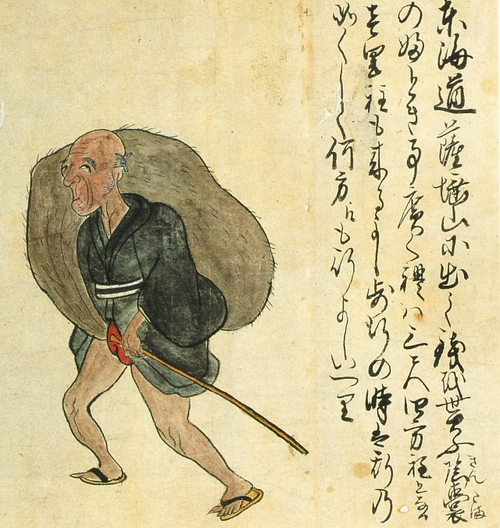
The Kaikidan Ekotoba is a mysterious handscroll that
profiles 33 legendary monsters and human oddities, mostly from the
Kyushu region of Japan (with several from overseas). The cartoonish
document, whose author is unknown, is believed to date from the mid-19th
century.
The above image tells a tale of a man with massive testicles
who reportedly made a living as a sideshow attraction at Mt. Satta, on
the old Tokaido Road near the city of Shizuoka. His scrotum is said to
have measured about a meter across.
Jose Guadalupe Posada (1852 - 1913) was Mexico’s most famous
graphic artist. He illustrated books, novels, and the famous broadsides
(news sheets) that were distributed throughout the country. Many of his
drawings could be considered to be political cartoons. Known especially
for his engravings of the “calaveras” or skeletons that cavort, eat and
drink, ride bicycles and horses, are revolutionaries, street vendors,
and everyday people.
His art is traditional for All Souls’ Day, the Day of the Dead
or “Dia de los Muertos”. The Day of the Dead actually consists of two
days: November 1st for the remembrance of deceased infants and children
and November 2nd for deceased adults.
Rockwell used a neighbor, Clarence Decker, as the sailor in the "Tattooist", 1944.
Decker was ‘Master of the Grange’ in Arlington, and shows up in quite a
few of Rockwell’s illustrations.
The Tattoo Archive received an email from Ross Mosher, who is
the great, great nephew of Clarence Decker, the sailor model for The
Tattooist, which read:
“Clarence didn’t have a single tattoo in real life. Also
the last name on his arm is Betty – that’s because my great, great aunt
Belle told Norman that if he put her name in the painting, she wouldn’t
speak to him ever again. So Norman crossed the L’s and added a Y.”
This illustration was found in the margins of a calendar in a
14th-century Flemish Book of Hours. Various historians of sport have
identified this as a version of “stool ball” or “stump ball”, which was
baseball played with only one base.
“Wound
Man” is an illustration which first appeared in European surgical texts
in the Middle Ages. It laid out schematically the various wounds a
person might suffer in battle or in accidents.
Late medieval anatomy works often contain a standard set of
illustrations, copied and recopied from text to text. Typically, these
depict the body front and back; the skeleton and muscles within it each
from the same two viewpoints, and so on. Strangest to our modern eyes is
the illustration that usually comes last: the Wound Man, a compendium
of all the injuries that a body might sustain. Captions beside the stoic
figure describe the injuries and sometimes give prognoses: often
precise distinctions are drawn between types of injuries, such as
whether an arrow has embedded itself in a muscle or shot right through.